Fiber laser cutting machines have become the core equipment for modern metal sheet processing industries. For most metal fabrication factories, small workshops and new business startups, choosing between a 3kW and 6kW fiber laser cutting machine is the most common and crucial decision. These two mainstream power models cover most daily metal cutting demands, but they differ greatly in cutting capacity, working speed, application range, budget cost and production efficiency.
First of all, the 3kW fiber laser cutting machine is the most cost-effective entry-level option for metal sheet processing. It performs perfectly in cutting thin and medium-thickness metal plates, including carbon steel, stainless steel, aluminum alloy and galvanized sheets within 0.5mm to 10mm. For daily processing of thin metal sheets such as electrical cabinets, decorative metal parts, kitchen hardware and small mechanical accessories, the 3kW laser cutter provides stable and precise cutting results with smooth edges and no burrs.
In contrast, the 6kW fiber laser cutting machine is an upgraded high-efficiency model for industrial mass production. With double the laser power of the 3kW machine, it greatly improves cutting speed and penetration ability. It can stably cut thicker metal sheets, including 20mm carbon steel, 12mm stainless steel and 15mm aluminum plates, covering both thin sheet rapid processing and thick plate heavy-duty cutting.
Below is a consolidated parameter comparison table for 3kW and 6kW fiber laser cutting, organized by material and assist gas. The speed ranges are drawn from production-oriented sources; actual values will vary with machine build quality, beam quality, gas pressure, and material grade.
3kW vs 6kW Fiber Laser Cutting: Thickness, Speed & Assist Gas Comparison
| Materiał | Assist Gas | Thickness(mm) | 3KW speed (m/min) | 6KW Speed (m/min) | Practical Note |
| Mild Steel | O2 (Oxygen) | 1 | 20-25 | 30-40 | Oxygen adds exothermic heat; fast on thin gauge |
| 3 | 8-12 | 14-20 | 6KW is roughly 1.7-2x faster | ||
| 6 | 3-4.5 | 6-9 | The 6KW advantage widens; oxygen pressure typically 0.6-0.9 bar | ||
| 10 | 1-1.5 | 2.5-4 | 3KW is near its comfortable ceiling | ||
| 16 | - | 0.8-1.3 | 3KW is not practical for continuous production at this thickness | ||
| 20-25 | 0.55-0.65 | 0.5-1 | 3KW speed shown is for near-max thickness; quality risk rises | ||
| Stal nierdzewna | N2 (Nitrogen) | 1 | 15-22 | 25-35 | Thickness -dependent spread; thinner sheet favors higher speeds |
| 2 | 12-18 | 20-30 | 6KW is 1.6-2x faster | ||
| 3 | 5-8 | 10-14 | the gap begins to widen significantly | ||
| 4 | 4-7 | 8-12 | 6KW roughly doubles throughput | ||
| 6 | 1.5-2.5 | 4-6 | 6KW often 3x faster at this thickness | ||
| 8 | 1-2 | 2.5-4 | 6KW becomes clearly preferable for repeat work | ||
| 10 | 0.5-0.6 | 1.2-2 | 3KW is at the edge of usable production | ||
| Aluminum | N2 (Nitrogen) | 2 | 15-18 | 20-25 | Aluminum de,ands higher energy input due to reflectivity and conductivity |
| 3 | 10-16 | 18-28 | 6KW speed advantage is substantial | ||
| 6 | 3-5 | 6-10 | 6KW roughly doubles production speed | ||
| 8-10 | 1-2 | 2.5-4 | 3KW is near maximum practical thickness for aluminum |
Assist Gas Notes & Compressed Air
| Gas | Typical Use Case | Edge Quality | Cost/Operational Note |
| Oxygen (O2) | Mild Steel/Carbon Steel | Thin oxide layer; acceptable for structural work, requires cleaning befor welding/painting | Low gas cost; exothermic reaction boost speed |
| Nitrogen (N2) | Stainless Steel, Aluminum | Bright, oxide-free, weld-ready edge | Higher gas cost; pressure often 10-20 bar for stainless, which materially effects operation cost |
| Compressed Air | Thin Aluminum (≤4mm) and thin Mild Steel (≤3mm) | Slightly rougher than N2; may show minor oxidation | Very low operation cost; suitable where cosmetic edge is not critical |
Note: Actual results vary by machine quality, nozzle condition, gas purity and material quality.
Wniosek:
1. The 6kW advantage is smallest on thin mild steel with oxygen—often only 20–30% in real cycle time—because the machine’s motion system becomes the limiting factor.
2. The 6kW advantage is largest on 4–8 mm stainless with nitrogen—frequently 2.5–3× faster than 3kW, making it the commercially decisive thickness band.
3. On thick mild steel (16–25 mm) with oxygen, the speed gap narrows again, but the 6kW wins on piercing speed and process stability rather than raw m/min.
4. Aluminum with nitrogen behaves like stainless but requires even more power headroom; 3kW is generally not recommended for production above 6–8 mm.
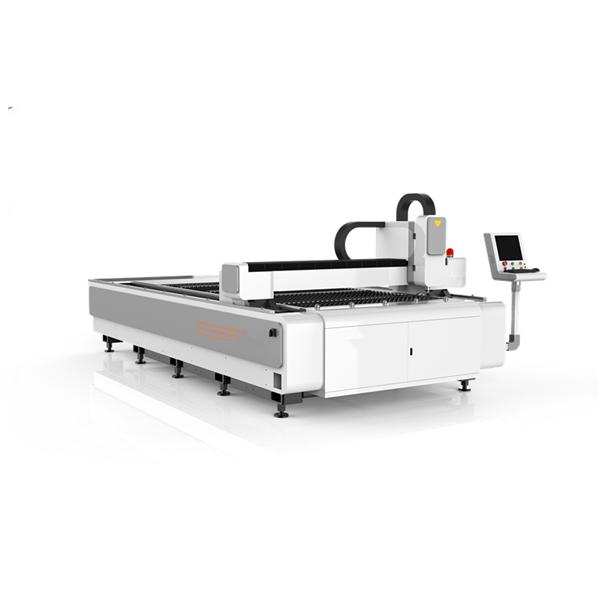
Laserowa maszyna do cięcia metalu
Odpowiednie materiały i branżey:
Nadaje się do precyzyjnego cięcia stali nierdzewnej, stali węglowej i niektórych innych materiałów metalowych, ma zastosowanie w technologii lotniczej, rakietach, samolotach, robotach, windach, parowcach i przemyśle samochodowym oraz przemyśle obróbki części metalowych do blach, reklamy, naczyń kuchennych, narzędzi bitowych, sprzętu itp.
The biggest advantages of the 3kW model are low investment cost, low power consumption and easy maintenance. It is very suitable for small factories, customized processing workshops and businesses with limited budgets and medium production volume. It can fully meet standard daily cutting tasks without unnecessary energy waste or high operating costs, making it a practical long-term production helper for small-scale metal processing.
In actual production, the 6kW fiber laser cutter is nearly twice faster than the 3kW model when processing the same thin metal materials. It maintains high-precision, oxide-free cutting edges even at high running speeds, which is ideal for high-standard industries such as automotive parts, architectural metalwork, industrial equipment and batch cabinet manufacturing. For medium and large factories with large daily output and mixed-thickness metal processing needs, the 6kW model greatly shortens production cycles and improves overall workshop productivity.
In terms of operating cost and applicability, each model has its own positioning. The 3kW fiber laser machine wins in budget-friendliness and energy saving, perfectly matching low-to-medium volume and thin-sheet processing. The 6kW machine features stronger versatility, higher efficiency and wider material adaptability, supporting diversified and high-volume industrial production.
To sum up, if you run a small workshop with limited budget and mainly process thin metal sheets, the 3kW fiber laser cutting machine is the best choice. If you need mixed processing of thin and thick metal plates, pursue faster production speed and long-term high-output development, the 6kW fiber laser cutting machine will bring greater economic benefits. Both models are reliable, stable and high-precision solutions for professional metal sheet fabrication.
Some fiber laser cutting machine is on sale now, please contact us freely to get best price of fiber laser cutting machine 3kw or 6kw. whatsapp:+8615165089127 christine@wisecnclaser.com